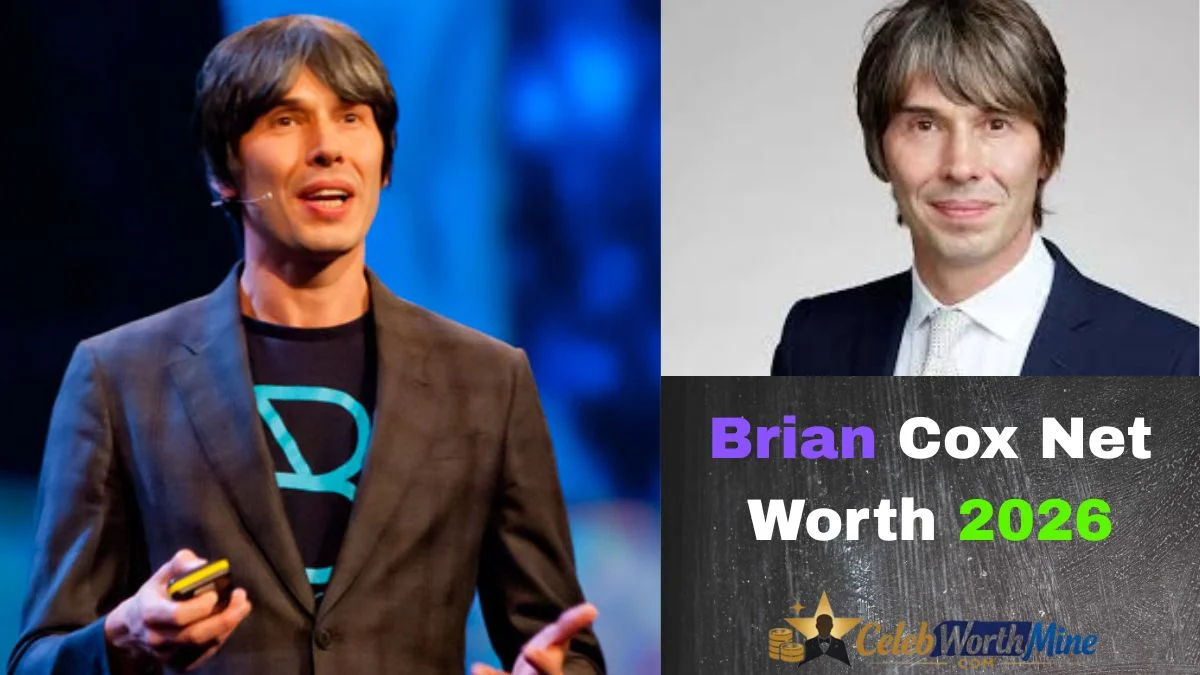
Brian Cox is one of the rare public figures whose career bridges music, science, and prime-time television. Once a keyboard player in the 90s pop band D:Ream, Cox walked away from chart success to follow his passion for particle physics, a decision that later turned him into the BBC’s most recognisable science communicator. By 2026, audiences aren’t just curious about his documentaries and books — they want to know how much this unique career path is actually worth. With hit BBC science series, bestselling popular-science books, sold-out live science tours, and ongoing academic work, Brian Cox’s income comes from far more than television alone. His net worth story reflects influence, expertise, and long-term credibility rather than celebrity hype.
Who Is Brian Cox?
Brian Cox is a British particle physicist, science communicator, and television presenter best known for making complex ideas about the universe accessible to a global audience. His career stands out because it combines academic research, public engagement in science, and mainstream broadcasting, a mix that has helped redefine how science is presented on television.
Quick facts:
- Full name: Professor Brian Edward Cox
- Date of birth: 3 March 1968 (58 years old in 2026)
- Profession: Particle physicist, university professor, author, TV and radio presenter
- University affiliation: Professor of Particle Physics at the University of Manchester
- Famous for: BBC science documentaries, co-hosting The Infinite Monkey Cage, popular science books, and his earlier career as a musician with the band D:Ream
His reputation is built on scientific credibility, long-term research experience, and trusted public communication, rather than short-term media fame.
Brian Cox Net Worth in 2026
Estimating the net worth of Brian Cox in 2026 isn’t straightforward because there’s no single official figure published by Forbes or a financial regulator — but we can build a credible estimate range by looking at his long career, ongoing projects, and how his wealth has grown over time based on multiple credible data signals.
Latest Estimated Net Worth (2026)
Based on available financial estimates and trend data, Brian Cox’s net worth in 2026 is likely in the range of roughly $10 million to $20 million. This aligns with expert net-worth databases and consistent growth patterns seen in recent years.
This estimate reflects his broad income streams, including academic salary, book royalties, TV and documentary fees, live science tours, and speaking engagements.
How His Net Worth Has Grown
Over the past several years, most assessments suggest a steady rise:
- In the early 2020s, estimates placed his wealth at around $8 million to $10 million.
- By 2024–2025, many experts cited estimates roughly in the $10 million to $18 million range, reflecting additional TV work and book sales.
This trend suggests gradual growth, not rapid windfalls — typical for a career built on long-term scientific credibility, media work, and diversified income rather than a single blockbuster project.
Why His Net Worth Has Increased
Brian Cox’s net worth hasn’t jumped overnight — instead, it has grown gradually due to several key factors:
- Television and Documentary Fees
His long-running BBC science series and other documentary work provide recurring presenter fees and exposure that translate into licensing and residual payments. - Book Sales & Royalties
Cox has authored and co-authored several popular science books that continue to sell worldwide. Royalties from translated editions and audiobook versions add up over time. - Academic Salary & Grants
As a full professor of particle physics at the University of Manchester, he earns a stable academic salary. Science grants and institutional funding also indirectly support his professional brand. - Live Tours & Public Speaking
In recent years, Cox has taken science communication beyond the screen with large-venue live shows, premium ticket tours, and keynote speaking — all of which are high-value revenue streams. - Public Engagement & Brand Value
His voice on radio, podcasts, high-profile interviews, and science festivals elevates his personal brand, boosting demand for paid appearances and collaborations.
How Brian Cox Makes His Money
Brian Cox’s wealth does not come from a single source. Instead, his income is built on multiple long-term, credibility-based revenue streams that combine academic expertise with mainstream media reach. This diversified model is one of the main reasons his net worth has remained stable and continued to grow into 2026.
🔸 TV & BBC Science Shows
A major portion of Brian Cox’s earnings comes from television documentaries and science series, particularly his long-running relationship with the BBC. As a recognised science presenter rather than a one-off contributor, he benefits from higher presenter fees, repeat commissions, and international licensing. Long-format documentary series also tend to generate value beyond initial broadcast through global distribution and educational use.
🔸 Books & Publishing Royalties
Cox has co-written several popular science books that translate complex physics into accessible language for general readers. Income here is not limited to first-year sales; it includes ongoing royalties, audiobook versions, and foreign-language translations. Over time, these publishing revenues accumulate steadily, supporting long-term financial growth rather than short spikes.
🔸 Live Tours & Public Speaking
In recent years, Brian Cox has expanded his reach through large-scale live science tours, often staged in theatres and arenas. These events typically command premium ticket prices and attract thousands of attendees per show. Alongside public tours, he is also in demand for corporate talks, university lectures, and science festivals, where appearance fees reflect his authority and global reputation.
🔸 University Salary & Research Roles
Despite his media profile, Cox remains an active academic. As a Professor of Particle Physics at the University of Manchester, he earns a salary consistent with senior UK academic standards. While university income is not his highest revenue stream, it adds financial stability and professional credibility, reinforcing his expert status across other platforms.
🔸 Music Royalties
Although music is no longer his primary career, Brian Cox still benefits from ongoing royalties linked to his time as a member of the band D:Ream. Songs such as “Things Can Only Get Better” continue to generate income through broadcast use, licensing, and streaming, providing a smaller but persistent passive revenue source.
Brian Cox’s Career Journey
Brian Cox’s career is often described as unusual, but what truly sets it apart is the deliberate shift from mainstream success to academic depth. In the early 1990s, he gained public attention as a keyboard player for the pop band D:Ream, experiencing chart success and international tours. Rather than chasing a long-term music career, Cox made a decisive choice to step away from the industry and return to his academic roots.
He completed a PhD in high-energy particle physics, focusing on fundamental questions about the nature of the universe. His research career later included work connected to CERN, placing him within the global scientific community rather than the entertainment world. Over time, his ability to clearly explain complex scientific ideas led to media opportunities, eventually positioning him as the BBC’s most trusted face of modern science communication — a role built on expertise, not celebrity.
Brian Cox’s TV Shows & Media Career
Brian Cox’s media career reflects consistency, authority, and long-term public trust, rather than one-off appearances. His work spans television, radio, and international broadcasting, making him one of the most recognisable science presenters of his generation.
📺 Major BBC Television Series
- Wonders of the Solar System
- Wonders of the Universe
- Human Universe
- Forces of Nature
- The Planets
- Universe and other later BBC science specials (continuing into the mid-2020s)
These programmes focus on cosmology, astrophysics, and fundamental physics, and are widely used for educational and international broadcast purposes.
🎙️ Radio & Audio Media
- Co-host of The Infinite Monkey Cage, a long-running BBC Radio 4 programme combining science discussion with humour and public engagement.
🌍 International & US Appearances
- Guest appearances and hosting roles on US television networks
- Participation in global science festivals, documentaries, and lecture series aimed at international audiences
His sustained media presence is built on scientific credibility, clear communication skills, and academic authority, which keeps his work relevant well beyond initial broadcast dates.
Books, Publications & Academic Impact
Beyond television, Brian Cox has built lasting influence through popular science writing and academic research. His books are designed to bridge the gap between professional physics and public understanding, translating complex ideas about space, time, and matter into clear, engaging narratives. These works are widely read by non-specialists, students, and educators alike, strengthening his role as a science educator rather than just a presenter.
Alongside his books, Cox has contributed to a large body of peer-reviewed research papers in particle physics. While much of this work sits within the academic community, it underpins his authority on screen and in print. This dual presence — research credibility combined with public communication — is the main reason he is respected far beyond television audiences.
Personal Life
Brian Cox maintains a low-profile personal life, choosing to keep family matters separate from his public work. He is married to Gia Milinovich, a science presenter and producer, reflecting a shared interest in science communication rather than celebrity culture.
The couple have one son, and they live in London, keeping their home life largely private. Cox is known for avoiding social-media oversharing and tabloid exposure, reinforcing a reputation built on professional substance, privacy, and balance, rather than public spectacle.
Awards, Honours & Recognition
Brian Cox’s contribution to science and education has been formally recognised through a range of national and academic honours. These awards reflect not only his research background but also his impact on public understanding of science.
- Appointed OBE / later CBE for services to science and public engagement
- Recipient of Royal Society–linked honours recognising science communication
- Awarded major physics and education medals for explaining complex scientific ideas to wider audiences
Such recognition positions him as a trusted figure within both academic institutions and public media, strengthening his authority across all platforms.
Brian Cox vs Other Famous Scientists
What sets Brian Cox apart from many well-known scientists is his balanced role between academia and mass communication.
🔹 Brian Cox vs Neil deGrasse Tyson
While Neil deGrasse Tyson focuses heavily on public commentary and popular science debate, Cox remains closely tied to active academic institutions and research culture. Cox’s style is more observational and educational, prioritising explanation over opinion, particularly in long-form documentaries.
🔹 Brian Cox vs David Attenborough
Unlike Attenborough, whose influence lies primarily in natural history storytelling, Cox’s impact centres on theoretical physics, cosmology, and fundamental science. His influence is less about narration and more about making abstract scientific concepts accessible, especially to younger audiences and students.
This positioning gives Cox a unique space — not just a presenter, not just a scientist, but a bridge between the two.
Future Projects & Earnings Potential
Looking ahead, Brian Cox’s career shows strong potential for continued growth. Ongoing demand for science-based documentaries, combined with renewed interest in space exploration and physics, keeps his television work relevant. New book projects, updated editions, and educational releases are likely to add long-term publishing revenue.
In addition, live science tours remain a high-value income stream, drawing large audiences and premium ticket sales. As public interest in science communication continues to rise, Cox’s trusted reputation suggests his earning potential and net worth may continue to increase steadily beyond 2026, driven by expertise rather than trend-based fame.
Frequently Asked Questions
What is Brian Cox’s net worth in 2026?
Brian Cox’s net worth in 2026 is estimated within a multi-million range, built through television work, publishing, live tours, and academic roles rather than a single income source.
Is Brian Cox still a professor?
Yes, he remains academically active and associated with university-level physics and research culture.
Does Brian Cox still earn from music?
He continues to receive limited but ongoing royalties from his time with the band D:Ream.
What makes Brian Cox different from other TV scientists?
His credibility comes from combining peer-reviewed research with long-term public science communication.
Conclusion
Brian Cox’s career reflects a rare balance of scientific authority, public trust, and consistent media presence. His net worth growth is driven by expertise-led work — from documentaries and books to live education and academia. Rather than chasing trends, Cox has built long-term value through credibility, making his influence and earnings sustainable well beyond 2026.