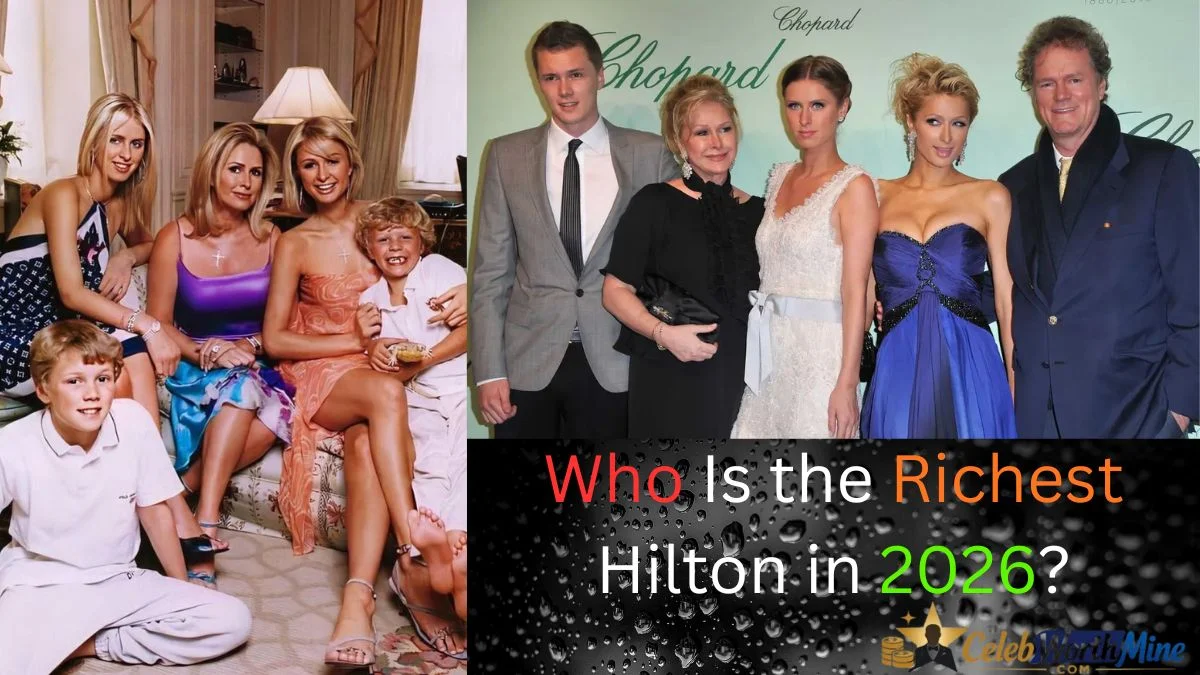
As of 2026, the richest members of the Hilton family by verified personal net worth are Rick and Kathy Hilton, with an estimated combined fortune of around $350 million, primarily built through luxury real estate brokerage and long-term investments. However, when marital wealth is considered, Nicky Hilton Rothschild becomes the wealthiest by association due to her marriage to billionaire financier James Rothschild, whose estimated net worth exceeds $1.5 billion. Close behind is Paris Hilton, who has transformed her global celebrity status into a $300 million self-made business empire spanning fragrance licensing, fashion retail, brand endorsements, and entertainment ventures.
Hilton Family Net Worth 2026
Below is a comparative wealth ranking of key Hilton family members based on publicly discussed business holdings, entertainment earnings, real estate ventures, brand licensing revenue, and long-term investment activity. These figures reflect estimated personal net worth in 2026 and exclude foundation-controlled assets or unverified inheritance assumptions.
| Rank | Name | Estimated Net Worth (2026) | Primary Wealth Source |
| 1 | Rick & Kathy Hilton | $350 Million | Luxury Real Estate & Investments |
| 2 | Paris Hilton | $300 Million | Global Brand, Licensing & Entertainment |
| 3 | Nicky Hilton Rothschild | $100 Million | Fashion & Private Investments |
| 4 | Kyle Richards | $100 Million | Television & Real Estate |
| 5 | Barron Hilton II | $5 Million | Modeling & Creative Ventures |
| 6 | Kim Richards | $400,000 | Acting & Media Appearances |
Wealth Context & Financial Structure
This ranking reflects active income streams such as brokerage commissions, product royalties, media contracts, fashion partnerships, and property holdings. It does not include historic hospitality empire valuations or charitable endowment assets linked to the Hilton legacy.
Rick and Kathy Hilton lead due to sustained earnings from high-value property transactions and capital appreciation. Paris Hilton follows closely with diversified revenue from licensing, fragrance distribution, brand collaborations, and digital media monetization. Nicky Hilton Rothschild and Kyle Richards maintain strong financial positions through fashion entrepreneurship and entertainment-based income, combined with strategic real estate exposure.
Barron Hilton II and Kim Richards represent smaller-scale wealth accumulation tied primarily to modeling, acting, and limited media engagements.
Note: Marriage-based wealth, particularly related to the Rothschild banking dynasty, is analyzed separately in the section below to maintain a clear distinction between personal net worth and combined household assets.
The Origins of the Hilton Fortune (1919–2007)
The financial foundation of the Hilton dynasty began in 1919, when Conrad Hilton acquired his first hotel property in Texas, marking the birth of what would later become one of the most recognized names in global hospitality. His business model centered on strategic property acquisition, operational efficiency, and brand standardization — principles that would later define modern hotel franchising and international expansion.
During the mid-to-late 20th century, leadership transitioned to his son, Barron Hilton, who played a pivotal role in scaling the enterprise into a multinational hospitality corporation. Under his stewardship, the Hilton brand strengthened its asset portfolio, expanded into global markets, and diversified through public market participation and corporate restructuring. This era marked the transformation of Hilton from a hotel chain into a global lodging powerhouse.
A landmark financial event occurred in 2007, when Hilton Hotels Corporation was acquired by Blackstone Group in a leveraged buyout valued at approximately $26 billion. This transaction represented one of the largest private equity acquisitions in hospitality history and fundamentally reshaped ownership of the Hilton brand.
Following Barron Hilton’s passing in 2019, a major estate decision redefined the distribution of the family’s historic wealth. Approximately 97% of his remaining fortune was directed toward the Conrad N. Hilton Foundation, significantly increasing its philanthropic endowment. Only a small percentage was allocated to direct heirs, reinforcing the family’s long-standing charitable commitment over dynastic inheritance accumulation.
From an economic perspective, this shift means that much of the original Hilton hotel empire wealth is now foundation-controlled rather than privately inherited — a critical distinction when analyzing the modern Hilton family net worth structure.
Hilton Fortune Timeline (1919–2007)
1919 – Conrad Hilton purchases his first hotel in Texas, entering the hospitality industry.
1940s–1960s – Rapid expansion across the United States; early international positioning begins.
1979 – Conrad Hilton passes away; leadership legacy continues.
1980s–2000s – Barron Hilton strengthens global expansion, asset restructuring, and corporate growth.
2007 – Hilton Hotels sold to Blackstone Group in a $26 billion buyout.
2019 – 97% of Barron Hilton’s estate directed to the Conrad N. Hilton Foundation, expanding philanthropic capital.
This historical context clarifies an important financial reality: while the Hilton name remains synonymous with luxury hospitality and generational wealth, the bulk of the original hotel empire capital is no longer directly controlled by individual family members. Modern Hilton net worth figures are therefore largely driven by independent business ventures, real estate holdings, media careers, and private investments rather than inherited hotel billions.
Rick & Kathy Hilton – The Real Estate Power Couple ($350M)
With an estimated combined net worth of approximately $350 million in 2026, Rick Hilton and Kathy Hilton represent the most financially established branch of the immediate Hilton household. Unlike the original hospitality fortune built decades ago, their wealth is primarily tied to high-end real estate brokerage, private capital allocation, media visibility, and long-term asset appreciation.
At the heart of their wealth is Hilton & Hyland, a premier luxury real estate brokerage based in Beverly Hills, which serves as the cornerstone of their financial portfolio.The company operates within the ultra-prime property market, specializing in multimillion-dollar estates, celebrity homes, legacy mansions, and high-net-worth clientele transactions.
Hilton & Hyland Business Model
The firm’s revenue structure is rooted in premium brokerage representation. Rather than volume-based sales, the company focuses on fewer but significantly larger transactions — often involving estates valued in the eight- to nine-figure range. In luxury real estate economics, commission percentages on such properties can generate substantial brokerage income even from a limited number of annual deals.
This boutique-style, relationship-driven model emphasizes:
- Exclusive listings
- Discretion for celebrity clients
- International buyer networks
- High-value residential portfolio marketing
By operating in the luxury property sector — where commission margins and transaction sizes are elevated — Rick Hilton’s earnings are closely aligned with market cycles, property appreciation trends, and capital movement within affluent communities.
RHOBH Exposure & Brand Amplification
Kathy Hilton’s recurring presence on The Real Housewives of Beverly Hills (RHOBH) has indirectly strengthened the couple’s brand equity. While reality television is not their primary income source, it enhances public visibility, personal branding, and social capital within elite circles.
Media exposure can translate into:
- Expanded client networks
- Higher perceived social status
- Business referral growth
- Licensing and collaboration opportunities
In high-net-worth industries, reputation and influence often function as intangible financial assets.
Philanthropy & Wealth Positioning
Beyond business income, the couple maintains involvement in charitable initiatives and fundraising events. While philanthropy does not directly increase net worth, it reinforces long-term legacy positioning, social trust, and elite community integration — all of which can indirectly support business sustainability.
This strategic blend of wealth preservation, social presence, and capital deployment reflects a legacy-driven financial philosophy rather than speculative accumulation.
Income Sources Breakdown
Below is a structured overview of their primary revenue channels:
1. Brokerage Commissions
The bulk of their fortune comes from high-end property sales and commissions generated by Hilton & Hyland. High-value estate sales generate substantial commission income tied to premium listing agreements and buyer representation.
2. Real Estate Investments
In addition to brokerage earnings, long-term holdings in residential properties and private investments contribute to asset growth through appreciation and equity accumulation.
3. Television & Media Appearances
While not their core financial driver, RHOBH exposure and related media engagements provide supplementary income and enhance their overall brand valuation.
Financial Perspective
It is important to distinguish between inherited Hilton hospitality wealth and the independently generated income streams of Rick and Kathy Hilton. Their estimated $350 million fortune reflects active real estate brokerage performance, capital investments, and strategic brand positioning — not direct control of the historical Hilton Hotels empire.
This distinction is critical when evaluating the modern Hilton family wealth structure in 2026.
Paris Hilton – The $300M Self-Made Empire
Paris Hilton has evolved far beyond early 2000s tabloid fame to become a diversified global brand operator with an estimated net worth of approximately $300 million in 2026. While the Hilton surname carries historic prestige, the majority of her personal fortune stems from licensing agreements, consumer product lines, entertainment contracts, and intellectual property monetization rather than direct hotel inheritance.
Her financial model reflects modern celebrity capitalism — where brand equity, digital visibility, and global retail partnerships generate scalable revenue streams.
Retail Empire
Paris Hilton’s commercial footprint spans more than 50 standalone retail locations globally and 19 branded product lines across categories such as fashion accessories, handbags, footwear, beauty, and lifestyle merchandise.
A defining element of her business structure is licensing distribution rather than ownership-heavy manufacturing. This means:
- Third-party partners handle production and logistics
- Hilton earns royalties per unit sold
- Risk exposure remains relatively low
- Global scalability increases
Collectively, her branded merchandise has generated over $4 billion in lifetime product sales worldwide. While total sales revenue does not equal personal profit, royalty-based agreements allow consistent long-term income through international retail markets.
This licensing-driven retail strategy positions her less as a traditional retailer and more as a brand licensor with global distribution leverage.
DJ Career & Live Performance Revenue
In addition to product-driven income, Paris established herself in the electronic music and nightlife circuit. At peak demand, she reportedly commanded fees approaching $1 million per DJ set in high-profile venues and international residencies.
Performance income in this segment is structured around:
- Event booking guarantees
- Residency contracts
- Festival appearances
- Brand-sponsored nightlife partnerships
Unlike one-time media contracts, DJ performance revenue provides high-margin event-based earnings, contributing significantly to annual cash flow during peak touring periods.
Fragrances & Licensing Portfolio
One of the most financially durable components of her empire is fragrance licensing. Celebrity fragrance economics operate on long-tail consumer demand, meaning products can generate recurring revenue years after initial launch.
Under global licensing arrangements:
- Manufacturing and distribution are handled by beauty conglomerates
- Hilton earns royalty percentages per bottle sold
- Brand extensions reduce operational overhead
Fragrance lines often outperform fashion items due to repeat purchases, wider demographic reach, and global retail penetration. This category alone represents a substantial portion of her long-term brand valuation.
Media Presence & Brand Capitalization
Paris Hilton’s career also includes television production, digital media, podcasting, and brand partnerships. Media exposure functions not just as income but as marketing infrastructure — maintaining relevance, expanding audience reach, and strengthening negotiation leverage in licensing contracts.
In the influencer economy, visibility equals monetizable brand equity. Her early adoption of reality television and social persona marketing positioned her as a prototype for modern influencer entrepreneurship.
Is Paris Truly Self-Made?
This question generates debate.
From a financial standpoint, Paris did not build her empire from economic disadvantage — she was born into an affluent, socially connected family. Access to capital, networks, and media exposure undeniably provided early advantages.
However, it is equally important to separate inherited privilege from operational execution. The bulk of her estimated $300 million fortune does not come from hotel dividends or foundation distributions. Instead, it stems from brand licensing, fragrance royalties, retail partnerships, DJ contracts, and intellectual property monetization.
In wealth analysis terms:
- She leveraged inherited visibility
- But monetized it independently
- Through diversified, revenue-generating ventures
Therefore, while not “self-made” in the traditional bootstrap sense, her financial portfolio reflects active enterprise building rather than passive inheritance accumulation.
This nuance is essential when evaluating Hilton family net worth rankings in 2026 — especially when comparing personal business empires versus generational legacy wealth.
Nicky Hilton Rothschild – Heiress or Billionaire by Marriage?
Nicky Hilton Rothschild occupies a unique position within the Hilton legacy — not because she dominates headlines, but because her wealth profile blends inheritance, entrepreneurship, and elite European banking lineage through marriage.
Unlike her sister’s high-visibility branding empire, Nicky’s financial structure is quieter, asset-focused, and family-oriented.
She married James Rothschild in 2015, linking the Hilton name to the historic Rothschild family — one of the most influential financial dynasties in modern economic history.
Personal Wealth (~$100M)
Nicky Hilton Rothschild’s estimated personal net worth sits around $100 million in 2026. Her wealth composition includes:
- Family inheritance allocations
- Fashion collaborations and capsule collections
- Luxury jewelry and handbag partnerships
- Trust structures and private investments
Her business model leans toward curated luxury positioning rather than mass-market scaling. This means fewer product lines than Paris Hilton, but higher-end brand alignment and strategic licensing.
In wealth analysis terms, her portfolio reflects asset preservation and capital management rather than aggressive commercial expansion.
The Rothschild Dynasty: Legacy Capital Explained
The Rothschild banking dynasty originated in the 18th century and expanded across major European financial centers including Frankfurt, London, Paris, Vienna, and Naples.
Key characteristics of Rothschild wealth structure:
- Multi-generational private banking networks
- Investment banking & asset management firms
- Global real estate holdings
- Agricultural, wine estate, and private equity assets
Unlike celebrity wealth that depends on media relevance, dynasty wealth typically operates through:
- Diversified financial instruments
- Long-term capital preservation strategies
- Low-public-visibility asset control
This distinction is critical when comparing personal celebrity net worth to family-controlled financial ecosystems.
Combined Household Wealth ($1.5B+)
While Nicky’s individual wealth is estimated near $100 million, her combined household wealth with James Rothschild is believed to exceed $1.5 billion when factoring in:
- Trust assets
- Investment vehicles
- Family-controlled holdings
- Private equity exposure
It’s important to clarify that dynasty wealth is rarely structured as a single liquid balance. Much of it is held in:
- Family trusts
- Strategic holdings
- Long-term equity positions
Therefore, combined wealth represents controlled capital influence rather than direct personal spending money.
Does Marriage Make Her the Richest Hilton?
This is where the debate intensifies.
If we measure individual net worth, Paris Hilton’s ~$300 million fortune surpasses Nicky’s personal ~$100 million.
However, if we measure household wealth influence, Nicky Hilton Rothschild arguably sits within a far larger capital ecosystem due to her connection to Rothschild banking assets.
So the answer depends on the metric:
- Individual entrepreneurial wealth → Paris leads
- Combined household capital power → Nicky’s position strengthens significantly
Marriage does not transfer dynasty ownership outright, but it certainly shifts access, network reach, and capital exposure.
From a financial hierarchy standpoint, Nicky may not be the richest Hilton individually — but structurally, she may sit closest to legacy banking power.
That nuance drives engagement in celebrity wealth comparisons.
Kyle Richards – Reality TV & Real Estate Wealth ($100M)
Kyle Richards built her fortune differently from both Hilton sisters — through television longevity and strategic real estate scaling.
Her estimated net worth stands near $100 million in 2026, with revenue streams anchored in reality television contracts and luxury property transactions.
RHOBH Salary Growth
Kyle became an original cast member of The Real Housewives of Beverly Hills (RHOBH), which significantly elevated her income trajectory.
Over time:
- Early seasons featured moderate episodic pay
- Contract renewals increased her per-season compensation
- Senior cast leverage boosted negotiation power
Long-running reality TV stars often benefit from:
- Syndication visibility
- Brand endorsements
- Sponsored social partnerships
- Reunion episode bonuses
Longevity equals leverage in unscripted television economics.
Husband’s Firm – The Agency
Kyle’s husband, Mauricio Umansky, founded The Agency, a high-end real estate brokerage specializing in luxury residential properties.
The Agency’s revenue model includes:
- Commission-based property sales
- International market expansion
- Celebrity and ultra-high-net-worth clients
- Development partnerships
Luxury real estate commissions can reach millions per transaction depending on property valuation — especially in Beverly Hills and global prime markets.
Property Deals & Real Estate Exposure
Beyond brokerage commissions, the couple’s wealth structure includes:
- Personal property investments
- House flips
- Appreciation gains in high-demand zip codes
- Strategic asset relocation
In contrast to media-based fame wealth, real estate provides:
- Tangible asset backing
- Inflation-resistant valuation growth
- Equity-based capital building
This diversification protects against volatility common in entertainment-driven income streams.
Kim Richards – From Child Star to Financial Struggles
Kim Richards began her career as a child actor in the 1970s, appearing in popular television series and movies that brought early fame and industry recognition. Roles in shows like Nanny and the Professor and James at 15 helped establish her as a talented performer from a young age.
However, over the years, Kim’s financial trajectory took a downturn due to personal and legal struggles. Multiple arrests, publicized legal issues, and challenges with alcohol and substance abuse significantly impacted her ability to generate consistent income.
Key factors affecting her net worth include:
- Reduced acting opportunities after early career
- Legal fines and court costs
- Losses from lifestyle and personal expenditures
Today, her estimated net worth is around $400K — a stark contrast to her more commercially successful family members. Despite these setbacks, Kim’s story highlights human vulnerability behind celebrity wealth, making her narrative relatable and engaging for readers.
Hilton vs Rothschild – Who Has the Bigger Legacy?
A high-authority discussion comparing the Hilton hospitality empire with the Rothschild banking dynasty emphasizes long-term legacy, intergenerational wealth, and societal influence.
| Family | Industry | Estimated Dynasty Wealth | Key Influence |
| Hilton | Hospitality | Billions (foundation-controlled) | Luxury hotels, brand licensing |
| Rothschild | Banking | Multi-billion private | Investment banking, global finance |
Hilton Legacy: Built through hospitality innovation, real estate, and brand licensing. Barron Hilton’s 2007 sale to Blackstone created a philanthropic shift, with 97% of fortune going to the Conrad N. Hilton Foundation, leaving a smaller portion for individual heirs.
Rothschild Legacy: A multi-generational banking dynasty with deep-rooted global financial influence, private equity holdings, and investment assets. Dynasty wealth is structured to preserve capital, ensure low-public visibility, and create generational continuity.
How Much Did Each Hilton Actually Inherit?
Contrary to popular belief, the Hilton heirs did not inherit the vast hotel billions. When Barron Hilton passed in 2019, only 3% of his fortune was shared among the eight children, 15 grandchildren, and four great-grandchildren.
Most of the Hilton fortune went to the Conrad N. Hilton Foundation, boosting its endowment from $2.9B to $6.3B and securing a long-term philanthropic legacy.
As a result, today’s wealth for Paris, Nicky, Kyle, and Barron II is largely self-created, coming from:
- Retail and fashion ventures
- Reality TV contracts
- Luxury real estate deals
- Entertainment appearances (DJ sets, endorsements, media projects)
Frequently Asked Questions
Who is the richest Hilton in 2026?
Rick & Kathy Hilton lead in personal wealth (~$350M).
Did Paris Hilton inherit billions?
No, Paris’ fortune is mostly self-made (~$300M).
How much did Hilton Hotels sell for?
Hilton Hotels sold to Blackstone in 2007 for $26 billion.
Is Nicky richer than Paris?
Individually, no; combined with Rothschild marriage, household wealth exceeds $1.5B.
What is the Hilton family combined net worth?
Exact combined wealth is private, but heirs’ personal fortunes range from $400K to $350M, excluding Rothschild-linked assets.
Who controls the Hilton Foundation?
The Conrad N. Hilton Foundation manages ~97% of the original estate, focusing on global philanthropy.
How much did each Hilton inherit?
Only 3% of Barron Hilton’s estate was distributed among heirs.
Are all Hilton heirs entrepreneurs?
Yes, most wealth today comes from self-made ventures in fashion, entertainment, and real estate.
Final Verdict – Who Truly Wins?
Here’s the breakdown across three key metrics:
- 🏆 Richest by bloodline: Rick & Kathy Hilton (~$350M) – their real estate empire and lifestyle investments make them the wealthiest direct bloodline holders.
- 🏆 Richest by self-made success: Paris Hilton (~$300M) – brand empire, retail lines, fragrances, DJ career, and licensing demonstrate entrepreneurial mastery.
- 🏆 Richest by marriage: Nicky Hilton Rothschild (household wealth ~$1.5B) – though her personal fortune is ~$100M, marriage into the Rothschild dynasty gives access to an enormous financial network and legacy.