A $400 million family trust. Private inheritance disputes. And Disney heirs who deliberately distanced themselves from one of the world’s most powerful empires.
While the Disney brand represents imagination, joy, and childhood wonder, the family behind it faced complex questions about wealth, control, and identity. For some heirs, extraordinary money created emotional conflict rather than security.
- So how did one of the most successful family legacies in history become a story of trust fund battles, quiet withdrawals, and inherited pressure?
Walt Disney’s Net Worth and the Birth of a Global Empire
Before Disney became a multinational entertainment corporation, it was built around the personal vision and financial risk-taking of one man: Walt Disney. At the time of his death in 1966, Walt Disney’s personal net worth is estimated to have been between $100 million and $150 million, equivalent to roughly $750 million to $1 billion today when adjusted for inflation.
Today, the Walt Disney Company is valued at over $130 billion, fueled by media networks, studio entertainment, theme parks, consumer products, and streaming platforms.Although the Disney empire is now worth over $130 billion, the family retains only a small ownership stake, with the majority of decision-making resting in the hands of professional leaders and corporate shareholders.
The family’s limited control contrasts sharply with the global reach of the brand they created. Walt’s legacy lives on through characters, theme parks, and international media influence, but the heirs are financially connected rather than operationally involved.
Why the Disney Family Owns Less Than 3% Today
Disney’s transformation into a publicly traded company meant that share dilution and institutional investment gradually reduced the family’s stake. Issuing new shares to fund theme park construction, acquisitions, and global expansion decreased the relative ownership of Walt and Roy’s descendants.
Walt intentionally discouraged his children and grandchildren from managing the company. Instead, professional executives and a board of directors guided decision-making. As a result, the family’s stake today represents wealth, not operational control, emphasizing the difference between ownership, influence, and legacy.
The Disney Family Tree Explained Simply
Understanding the family helps clarify the inheritance and dynamics:
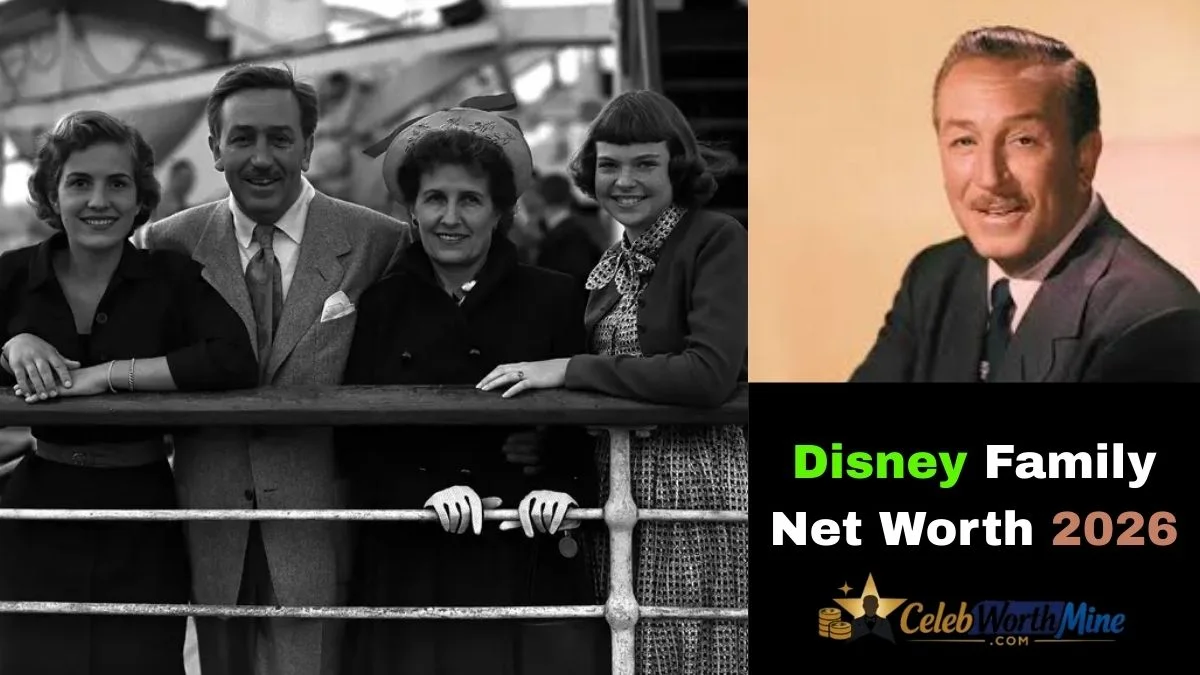
- Walt Disney: Two daughters, Diane and Sharon
- Diane and her husband Ronald Miller raised seven children—Chris, Joanna, Tamara, Jennifer, Walt, Ron Jr., and Patrick—giving them a relatively normal upbringing while keeping the Disney legacy at a distance.
- Sharon’s children: Victoria (adopted), Brad & Michelle
- Roy O.’s grandchildren: Susan, Roy P., Tim, Abigail
This structure shows why trusts and payouts became complex. The family spans multiple generations with differing priorities, which influenced both inheritance disputes and philanthropic choices.
The $400 Million Disney Trust Fund That Sparked a Family War
Following Walt Disney’s passing, a structured family trust was created to manage and allocate his fortune among his children and grandchildren over time.Payments were scheduled at ages 35, 40, and 45, with a combination of annual and lump-sum disbursements.
Conflicts arose when Brad and Michelle Disney disagreed over management and distribution. Trustees withheld Brad’s share due to concerns about his cognitive ability, while Michelle received her payments. Legal disputes highlighted the delicate balance between wealth, trust management, and family well-being.
The case demonstrates how even a well-structured trust fund can lead to emotional and legal complications, particularly when family members have different needs or capacities.
Abigail Disney: The Heiress Who Rejected Billionaire Life
Abigail Disney has publicly discussed the emotional challenges of inherited wealth, describing feelings of guilt and an inferiority complex. She uses her fortune to support philanthropy, social activism, and international documentary filmmaking.
Unlike some heirs who focused on luxury, Abigail emphasizes moral responsibility, advocating for wealth taxes and criticizing corporate practices, such as Disney layoffs and executive bonuses during crises. Her choices reflect a conscious decision to balance inherited fortune with purpose and social impact.
Luxury, Silence, and Activism: The Very Different Lives of Disney Heirs
While Abigail uses wealth for social change, other heirs lead private, lavish lifestyles. Some own multiple homes, travel extensively, or invest in real estate. Yet the family has collectively contributed millions to charitable initiatives, including children’s hospitals, arts programs, and wildlife conservation.
This contrast highlights a key lesson: wealth amplifies values — some choose visibility and philanthropy, others privacy and discretion.
Why Disney Heirs Stay Away From the Company
Most family members maintain distance from corporate leadership, partly due to Walt’s intentions and partly because of the pressures of public scrutiny and internal family conflicts.
This distance allowed Disney to grow into a global empire managed by professional executives, but it also meant that the family’s legacy is mostly symbolic, tied to intellectual property, branding, and trusts rather than day-to-day operations.
Philanthropy Over Power: How the Disney Family Uses Its Wealth Today
- Lillian Disney funded major cultural projects
- Sharon Disney Lund Foundation focuses on cancer research and arts education
- Abigail Disney’s Fork Films supports social justice and global awareness
- Roy + Patricia Disney Family Foundation emphasizes equality, sustainability, and community impact
Through these channels, the Disney family balances legacy, responsibility, and societal impact, demonstrating that wealth can be a tool for influence beyond corporate control.
The Dark Truth About Inherited Fortunes
The Disney story shows that extraordinary wealth brings unique pressures:
- Family conflict over trust management
- Emotional consequences of inherited responsibility
- Social scrutiny and public expectations
- Personal struggles with identity and purpose
The case illustrates the difference between creating wealth and inheriting it, emphasizing that money alone does not guarantee happiness or influence.
Lessons From the Disney Family Story
- Wealth amplifies personality, values, and conflict
- Ownership does not guarantee control or fulfillment
- Planning and governance are crucial for multi-generational estates
- Philanthropy can provide purpose when personal identity is challenged by inherited fortune
Read More..
- Marcus Wareing Net Worth 2025: Restaurants, TV & Wealth Breakdown
- Matt Groening Net Worth 2025: Salary & Wealth Breakdown
- What Is Bob Dylan’s Net Worth in 2025?
- Rain Brown Net Worth 2025: How Rich Is She?
- Simon Jordan Net Worth in 2026: Wealth Revealed
- Princess Andre Net Worth 2026: Earnings Revealed
- Shobhit Nirwan Age (2026), Net Worth, Education & Success
- Pauline Quirke Net Worth 2026: Income & Career Overview
- DaniLeigh Net Worth 2026: Income & Wealth Update
- Leo Skepi Net Worth 2026 – Income, Lifestyle & Career
FAQs
What was Walt Disney’s net worth at death?
Estimated $100–150 million in 1966 (~$750M–$1B today).
How much does the Disney family own today?
Less than 3% of the company.
Who inherited Walt Disney’s fortune?
His two daughters, Diane and Sharon, and subsequent grandchildren through trusts.
Why did the $400 million trust fund cause conflict?
Disputes over management, cognitive ability, and trustee decisions led to legal battles.
Are Disney heirs involved in the company today?
Most have deliberately stayed away; the company is run by professional executives.
Conclusion
Disney’s empire outgrew its family. While Walt Disney created a global media and entertainment powerhouse, the heirs inherited wealth, not operational control. Some embraced philanthropy, some chose privacy, and others faced emotional challenges.
Ultimately, the Disney story is a lesson in wealth, legacy, and responsibility — showing that an empire can thrive while the family itself navigates the human complexities behind the fortune.